
Can you relate to this? You’ve laid down a beautiful, soft wash of Yellow Ochre for a sunset. You decide to drop in a tiny touch of Phthalo Blue at the top for a bit of contrast. Suddenly, the blue doesn’t just sit there—it explodes. Within seconds, your golden sunset has been invaded by an aggressive green tide.
In the watercolor community, we often talk about “pigment personality.” Some colors are polite, staying exactly where you put them. Others are aggressive “pushers” that won’t stop until they’ve conquered every inch of the wet surface of your paper.
The Science of the “Push”
Why does this happen to watercolor pigments? It isn’t magic; it’s physics. There are two main reasons a pigment decides to take over the neighborhood:
- Particle Weight (Specific Gravity): Think of pigments like people in a swimming pool. Earth pigments (Siennas, Ochres) and mineral pigments (Cadmiums, Cobalts) are physically heavy. They sink into the “valleys” of the paper and stay there. Synthetic pigments (Phthalos, Quinacridones) are lightweight and finely ground. They float on the surface tension of the water, allowing them to travel long distances.
- Surfactants: Manufacturers add dispersants (like Ox Gall) to help paint flow. Some brands add more than others. When a “high-flow” paint meets a “low-flow” paint, the high-flow paint literally shoves the other pigment out of the way.
Brand Comparison: Who are the Fastest Movers?
Not every brand of “Phthalo Blue” behaves the same way. The binder and the amount of dispersant used by the manufacturer of watercolor pigments change how “pushy” the paint is.
The “Speedsters”: QoR (by Golden)
QoR is the undisputed heavyweight champion of “pushy” paint. Instead of traditional Gum Arabic, they use a synthetic binder called Aquazol. This binder allows for a massive pigment load and incredible dispersal. If you drop a dot of QoR into a wet wash, it will travel significantly further and faster than almost any other brand. It is the ultimate “bully” brand.
Here is a little video about the QoR watercolor pigments.
The “Punchy Performers”: Van Gogh & Sakura Koi
Van Gogh (Talens): For a student/intermediate brand, Van Gogh has surprisingly high flow. They are designed to be vibrant and easy to mix. Their synthetic colors (the “Permanent” reds and violets) are very active. They aren’t as violent as QoR, but they will easily shove an earth tone across the paper.
Sakura Koi: These are often “creamy” because of the binders used in their pan sets. While they have high tinting strength (the color is very bright), they don’t always have the “explosive” travel of professional fluids. However, their bright “Hues” (like Viridian Hue) are very lightweight and will still dominate heavier mineral colors.
The “Traditionalists”: Winsor & Newton & Daniel Smith
Winsor & Newton (Professional): These are the gold standard for predictability. They use high-quality Gum Arabic and a balanced amount of Ox Gall. Their pigments move well but are generally “polite.”
Daniel Smith: Known for their Primatek line (made from real minerals). Because many of their paints are made from actual rocks (like Lapis Lazuli or Hematite), they are often “Wallflowers”—they are heavy, they granulate, and they stay put. However, their Quinacridones are still very “pushy.”
The “Stay-Putters”: Holbein
Holbein is unique because they generally do not add Ox Gall (dispersant) to their paints during manufacturing. They want the artist to control the flow by adding their own ox gall if needed. Because of this, Holbein pigments are often the “shiest.” They stay exactly where you drop them compared to a brand like QoR or Van Gogh.
The “Smooth Operators”: M. Graham & Schmincke
M. Graham: They use blackberry honey in their binder. This keeps the paint moist and gives it a very smooth, syrupy flow. They move beautifully and consistently, but they don’t “explode” quite as aggressively as the synthetic binders.
Schmincke Horadam: These are designed for ultimate control. They use a very specific formula of Ox Gall for each individual pigment to ensure they all behave as similarly as possible.
The Lineup: Know Your Players
Regardless of the brand, certain watercolor pigments are almost always “Bullies” or “Wallflowers.” Check your tubes for these pigment codes:
The “Bullies” (High Dispersal / Aggressive)
- Phthalo Blue (PB15) & Phthalo Green (PG7): The kings of the playground. They will dominate any mix.
- Quinacridones (PV19, PR122): Found in Rose, Magenta, and Violet. They move with lightning speed.
- Prussian Blue (PB27): A very “fast” mover that can quickly turn a painting dark and moody.
- Perylenes (PBk31, PR179): High tinting strength and very decisive movement.
The “Wallflowers” (Low Dispersal / Passive)
- Yellow Ochre (PY42) / Raw Sienna (PBr7): The classic “victims.” They are heavy and easily pushed into “veins.”
- Cerulean Blue (PB35/PB36): A heavy, granulating pigment. It sinks into the paper and refuses to budge.
- Cadmiums (PR108, PY35): These are heavy metal pigments. They are “lazy” and don’t like to travel.
- Potter’s Pink (PR233): One of the “laziest” pigments in existence. It stays exactly where it lands.
Battle of the Watercolor Pigments: 2 Experiments to Try
Grab a scrap of 100% cotton watercolor paper, get it evenly wet, and try these “battles” to see the difference for yourself.
Battle 1: The Invasion (Phthalo Blue vs. Yellow Ochre)
Drop a juicy bead of Yellow Ochre on the left. Drop a bead of Phthalo Blue on the right. Watch the border where they meet.
The Result: The Blue will charge into the Ochre. You’ll see the Ochre get compressed into a dark, jagged line as the Blue takes over the space.
Battle 2: The “Glow” Effect (Burnt Sienna vs. Quinacridone Rose)
Lay down a wash of Burnt Sienna. While it’s very wet, drop a tiny dot of Quinacridone Rose (or Van Gogh Madder Lake) into the center.
The Result: The Rose will “push” the brown away, creating a bright, glowing pink “halo” around the drop. This is a great way to paint flowers or light sources.
Pro Tips for Managing “Pushy” Paint
- The Order of Operations: If you want a soft, diffused look, put your “Wallflowers” (Earth tones) down first, then drop your “Bullies” into them.
- Water Control: A “Bully” pigment needs water to travel. If you want to use Phthalo Blue but don’t want it to take over, use a “dryer” mix (more paint, less water) on your brush.
- Embrace the “Veining”: When a bully pigment shoves a passive one, it often creates “backruns” or “blooms.” Instead of fixing them, use them! This texture is perfect for painting rocks, rusted metal, or stormy clouds.
The Takeaway: You don’t need to be afraid of the “bullies” on your palette. Once you know who they are, you can stop fighting them and start using their energy to create dynamic, exciting effects with watercolor pigments!
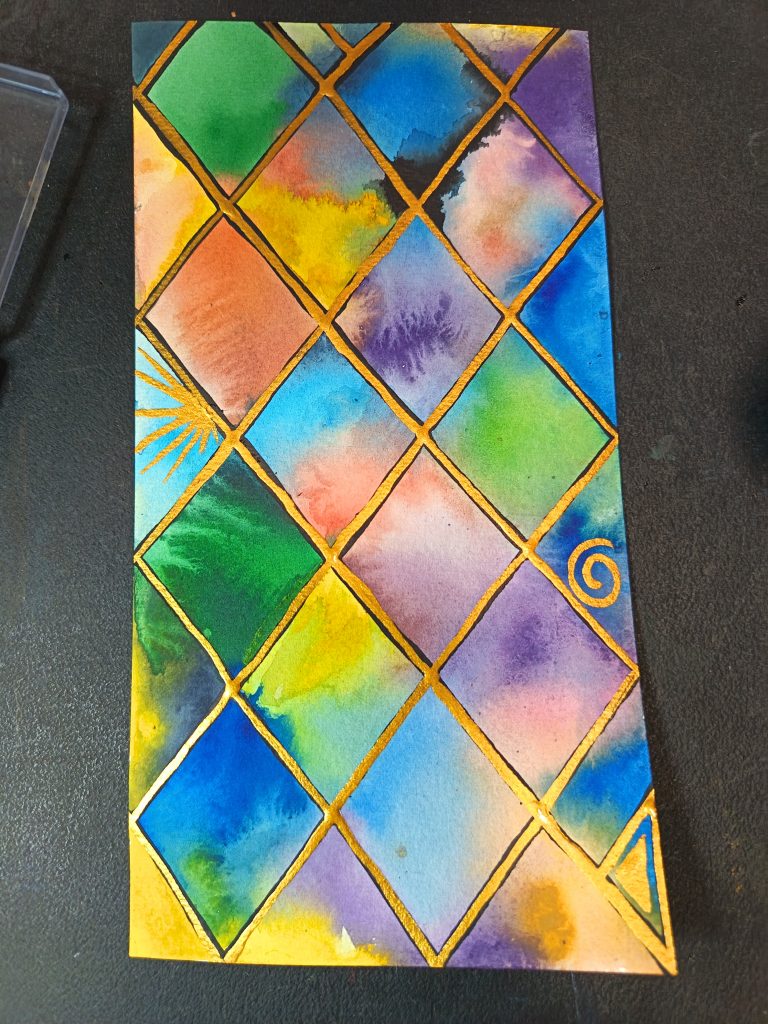
If you want to learn more about the stained glass technique on this article’s images – both of these were paintings by me, Mari Evenson, please check out this article and also this one that also includes more details on watercolor pigments.