A couple of weeks ago, I was looking for watercolor exercises (or watercolor drills if you will) that could help painters improve their skills while also giving them permission to just play — to explore color and movement without worrying about making a “finished” painting.
That’s when I came across a video by Emma Jane Lefebvre called Watercolour Drills: How to Master Wet on Wet and Colour Bleeds. The moment I saw her circles of color meeting and merging, I was completely enchanted.
It reminded me why I fell in love with watercolor in the first place — that magical moment when two colors touch and suddenly start to dance.
Of course, I had to try it myself.
Setting Up the Experiment
I actually did this for Painting Tips with Mari — that’s the weekly painting exercise our members can try at home. For this one, I wanted to see how my own paints would behave in the same kind of circle exercise Emma demonstrated.
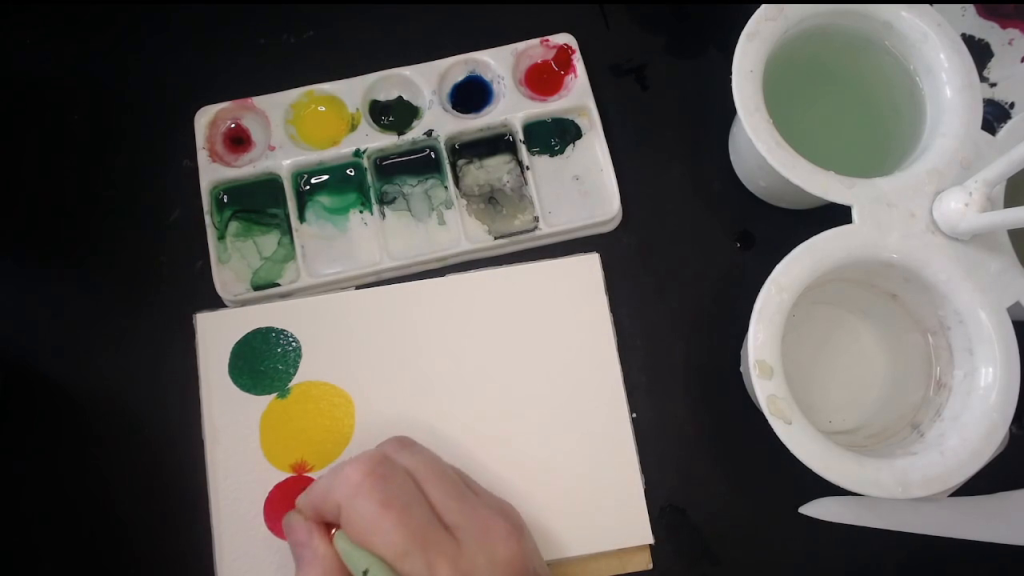
I used my Van Gogh paints and added a few drops of ox gall liquid to one of my water pots. (If you’ve never used ox gall before, it’s a wetting agent that helps watercolor flow more freely across the paper — it can make colors travel farther and blend more dramatically.)
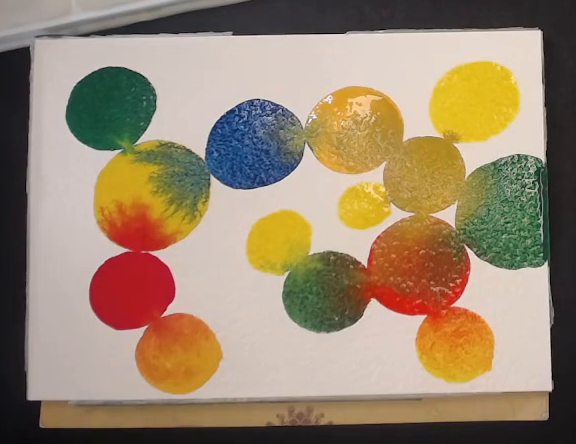
I set up three little pots: one with clean water, one with rinse water, and one with the ox gall mixture. Then I began painting small circles of color — reds, yellows, greens, blues — connecting them one by one to see what would happen when they met.
Watching the Magic Happen
The first thing I noticed was how alive everything looked. Some colors were shy, staying politely within their circle. Others were bold — pushing into neighboring colors, crossing boundaries, and creating new shades where they met.
When I connected a red and a green, they started creeping into the yellow next to them, almost like they couldn’t resist. The Prussian Blue, though — that one was the real troublemaker. It charged right into the yellows, completely taking over.
Even when I used two yellows — Lemon Yellow and Azo Yellow Dark — both were quickly overpowered by that strong, confident blue. It was fascinating to watch.
Then I tried adding a drop of the ox gall water directly into one of the circles. Instantly, the pigment began to move and spread, pushing outward like a flood. It was mesmerizing.
Every Paint Reveals It’s Personality in this Watercolor Drill
Here’s where things got really interesting.
Even though I used the same brand for all my paints, I could still see huge differences in how each color behaved. Some granulated, some spread smoothly, some sank while others floated. That’s when it really hit me — every paint has its own personality.
And here’s the thing: if you’re following along with a video like Emma’s, your paints might not act the same way hers do.
Every brand uses different formulas, binders, and pigment mixes. Even if two colors share the same name — say, “Prussian Blue” or “Cadmium Red” — they might behave completely differently depending on the brand. The only way to really know how your paints behave is to test them yourself.
So, while it’s fun to follow along with tutorials, this kind of exercise helps you build a personal relationship with your palette. No one else can tell you exactly what your paints will do — you have to see it for yourself.
Watercolor Drills: Learning Through Play
What I love most about this kind of experiment is that it feels like play, but it’s also real learning.
You start to understand how much water changes everything — how a wetter circle might invite another color in, while a drier one holds its ground. You see which pigments are pushy and which are quiet. You learn how ox gall or even just clean water can shift the balance of a painting.
And all of that knowledge quietly builds your confidence. The next time you’re painting a flower or a sky or a shadow, you’ll already know how those colors will behave when they touch.
Try It Yourself
Even if you haven’t done any watercolor drills before, I really encourage you to give it a try.
All you need is your usual palette, a brush, and some watercolor paper. Paint a few circles of different colors, connect them while they’re still wet. Watch what happens when they meet — which colors blend, which repel, which take over.
Don’t worry about making something pretty. Just observe. Take notes if you like. You’re getting to know your paints on a deeper level — how they move, how they mingle, and how they surprise you.
The Magic Never Gets Old
Even after years of painting, watercolor still finds ways to surprise me. It’s alive in a way no other medium is — unpredictable, playful, and endlessly fascinating.
Watercolor drills like this remind me that watercolor isn’t about control; it’s about relationship. The more you explore, the more you learn to trust it — and yourself.
If you’d like to see the original video that inspired this exercise, you can find it here: Emma Jane Lefebvre’s video.
Happy painting,
Mari